Sons of the Fighting Irish
A story built on grit, brotherhood, and the refusal to quit.
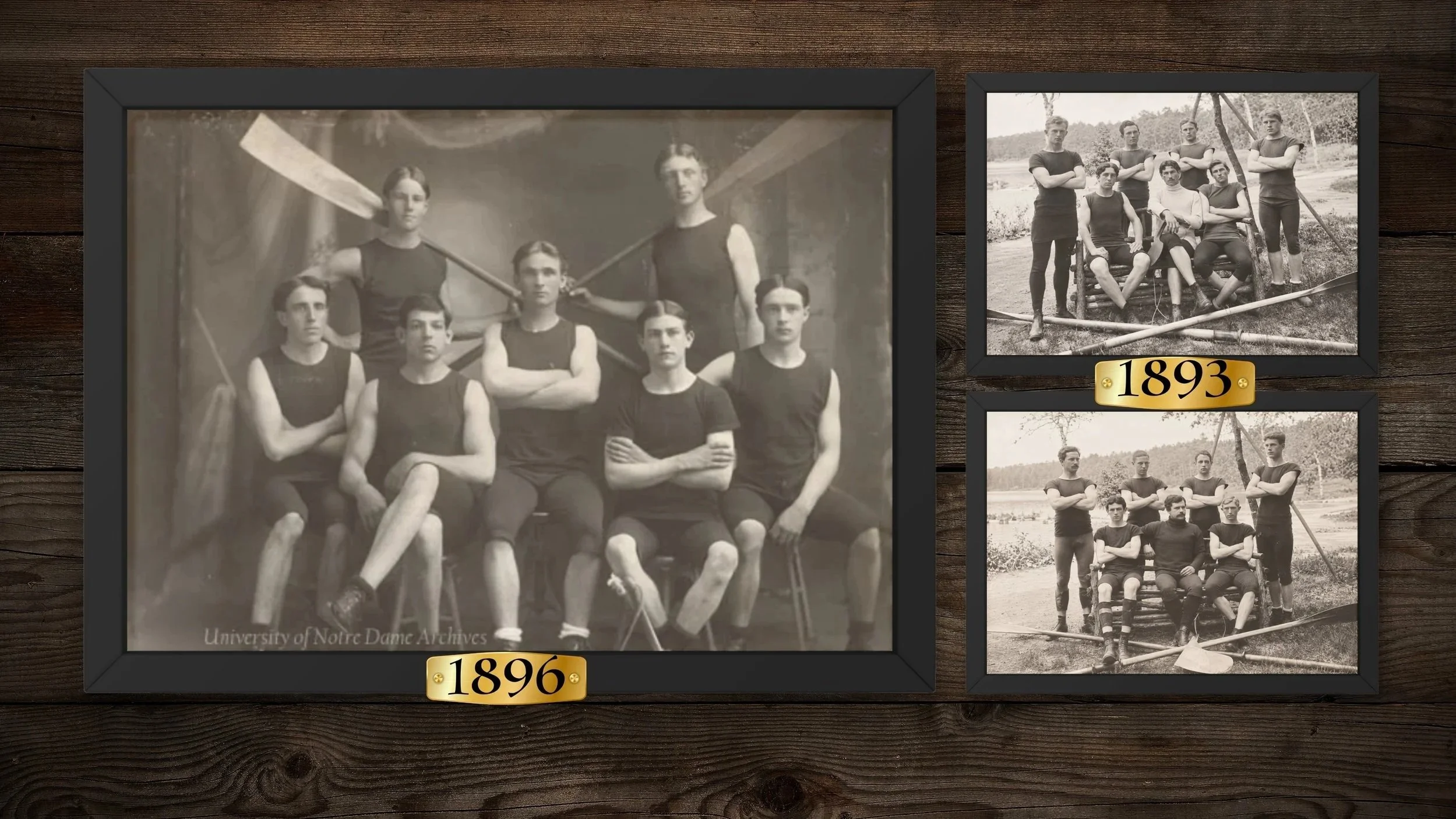
Rowing at Notre Dame reaches back almost as far as the University itself, with photographs documenting crew teams as early as 1893. But the modern tradition of Notre Dame Men’s Rowing began in 1964, when a determined group of students set out to build a competitive rowing program on the St. Joseph River.
They had almost nothing.
No established boathouse. Little equipment. Borrowed launches. Patched shells. Coaches who improvised from the riverbank and, at times, from a bicycle with a megaphone.
And yet, in May 1965, Sports Illustrated came to South Bend to tell their story. Its feature, “Up a Muddy River in a Beat-Up Shell,” introduced the country to Notre Dame’s fledgling crew during its first competitive season — a group of inexperienced rowers being held to standards far higher than their circumstances suggested they should expect.The magazine acknowledged how far the young Notre Dame crew had to go to catch programs like Harvard, but saw something else already taking shape: “if tenacity and enthusiasm mean anything in crew, they are well on their way.”
That tenacity became the tradition.
For more than sixty years, generations of Notre Dame rowers have taken what they inherited and pushed it forward. They built boats, raised money, recruited teammates, trained through South Bend winters, traveled across the country to race, and created a brotherhood that continued long after graduation.
The makeshift operation on the St. Joseph River eventually became a nationally competitive program. In 2024, Notre Dame Men’s Rowing captured the ACRA Varsity Eight National Championship, achieving a goal generations of rowers had chased for nearly sixty years.
But the history of Notre Dame Men’s Rowing is bigger than one championship. It is a history of people who refused to lower the standard because the road was difficult.
Today’s rowers inherit that tradition.
To row for Notre Dame is to add your name to a story that began long before you arrived — and to leave something behind for the crew that comes next.